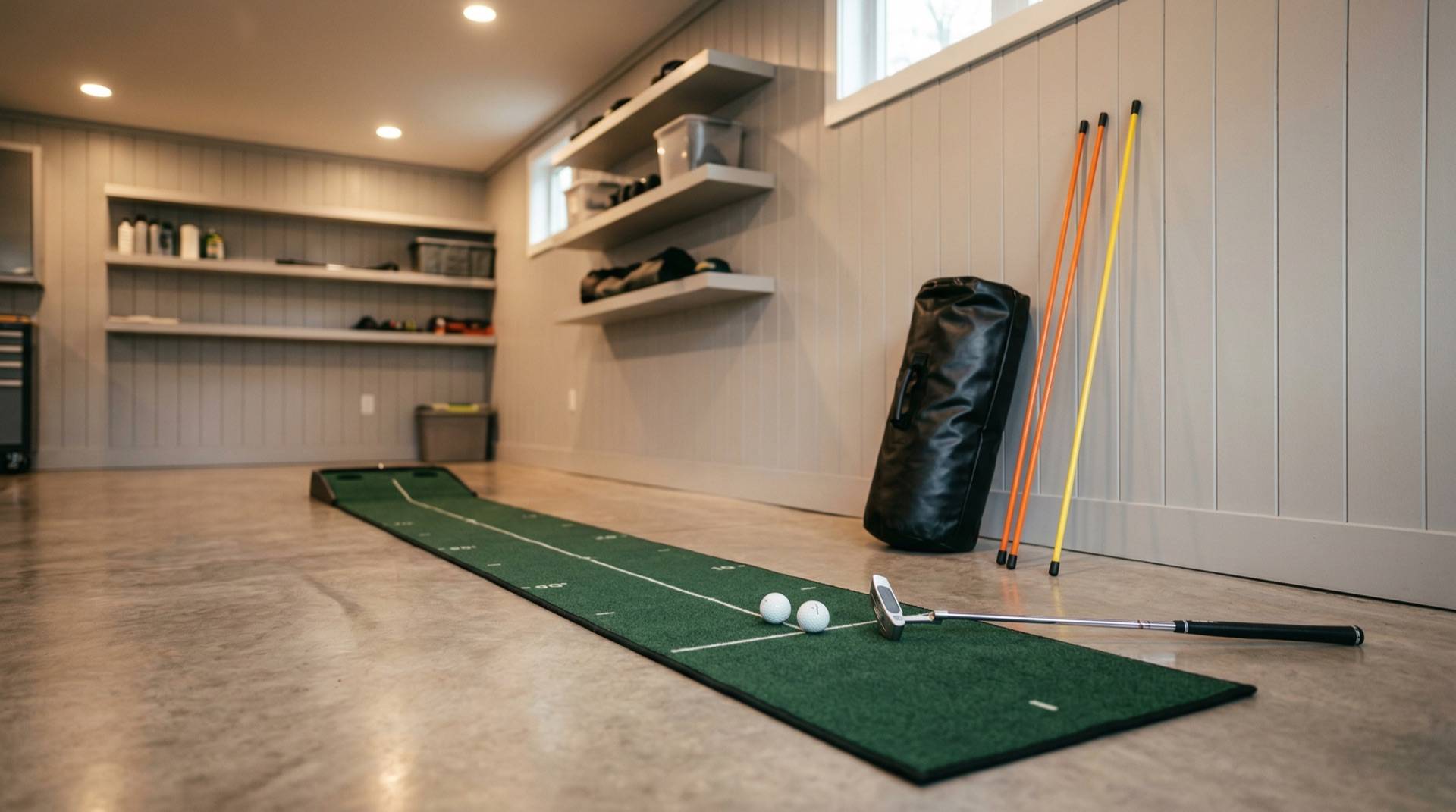
The Best Home Golf Practice Equipment Starts With the Setup, Not the Gadget
Most golfers do not have a home golf practice equipment problem. They have a buying-order problem. They pick up a random mat, a flashy swing gadget, and maybe a net that folds into the corner of the garage, then wonder why nothing changes when the scorecard starts bleeding on the back nine.
After you spend enough time around home practice setups, a pattern becomes obvious: the gear that actually helps is usually the least theatrical. It sets up fast. It gives rude, immediate feedback. It makes it hard to cheat the rep. The junk does the opposite. It feels clever for ten minutes, then turns into one more thing you step over on the way to your lawn mower.
This guide is intentionally more opinionated than a generic "best golf training aids" list. I am not trying to name every product category Everglade carries. I am trying to answer the question a serious golfer actually has: if you want home golf training equipment that sharpens scoring shots, cleans up ball flight, and gives you repeatable work between rounds, what deserves space on the floor first?
My rule is simple: coach the problem first, then recommend the product. That means every section below starts with the kind of golfer the tool helps, the benchmark it should improve, and the practice pattern it needs to support. Only then do we attach a product name.
Putting Reality
19%
Arccos says golfers in the 16-20 handicap range three-putt 19% of greens, and 21-25 handicaps jump to 23%. That is why I would rather see a golfer own one honest putting trainer than three vague swing gadgets.
Arccos practice dataShort Game Reality
40 ft
Shot Scope's amateur data shows 60-100 yard shots from the fairway finish about 40 feet away on average, then drift to 46 feet from rough and 56 feet from bunkers. Landing-spot training matters more than hero-shot fantasies.
Shot Scope approach statsSpeed Reality
+3 yds
TrackMan notes that adding 1 mph of club speed can add up to 3 yards with the driver. That is enough to justify speed work, but only if the tool helps you move faster without turning your motion into a mess.
TrackMan club-speed guideHow We Choose Home Golf Training Aids
We use a simple five-part screen when we decide whether a golf training aid belongs in a serious home setup. It is not fancy, but it keeps us from getting fooled by a good demo video. If a product cannot answer these questions clearly, it probably does not deserve your money.
Feedback quality
ClearDoes the tool tell you something specific on every rep - start line, strike, rotation, speed, or connection - or does it just create the vague feeling that you practiced?
Friction to use
LowIf setup takes ten minutes, the product will lose to real life. The best home equipment gets from closet to first rep fast enough that you actually use it on a Tuesday night.
Transfer to the course
RealA product should improve something you can see on the golf course, not just in the garage. Better speed control, tighter strike, cleaner rotation, and more centered contact all transfer.
Space efficiency
PracticalGood home tools respect the room you have, not the room you wish you had. If a product only works in a giant bay, it is not a realistic recommendation for most golfers.
Longevity
DurableThe good stuff stays useful after the honeymoon phase. You should still want it in the setup six months later because it keeps exposing the same miss when the swing gets sloppy.
The strongest products are the ones that answer most of those questions without a long explanation. More limited tools can still help, but only when the miss pattern is clear. That screen is why this list is restrained. The point is not to recommend more products. The point is to recommend fewer, better ones.
Best Golf Putting Aid for Home Practice
If you are trying to lower scores quickly, the most boring answer is usually the correct one: start on the ground, not at full speed. Home putting work wins because it is frictionless. You can get real reps before work, between meetings, or while the kids are doing homework, and the feedback loop is brutally clear. The ball either starts on line and rolls the intended pace or it does not.
That clarity matters because most golfers do not need a mystical putting breakthrough. They need a tool that makes bad face control impossible to ignore. If you can build cleaner start-line reps from four to eight feet and improve your pace discipline on longer putts, you have already made the home setup worth it.
Recommended pick
Putting Arc T3
Best for golfers who need start-line honesty
Roughly a $25 entry point on the live catalog as of April 9, 2026.
The T3 is a strong first recommendation because it forces the path question into the open immediately. If your stroke gets loose, you know. If your face delivery improves, you feel it. Use it for short blocks of ten to fifteen deliberate reps, then go straight into make-rate work on the floor or a mat.
If you already know you are committed to putting practice and want a more premium station, the mirror-bundle style upgrade is the right next step because it adds setup accountability instead of more noise. The important principle is that your putting setup should coach posture, face control, and start line at the same time.
Putting tools should make your stroke simpler, not more decorative.
Best Short Game Training Aid for Backyard and Garage Reps
Short game gear gets mis-sold all the time. The internet loves magical wedge products that promise touch, but touch is usually just repeated contact plus better landing-zone discipline. You do not need a trick shot station. You need a target that makes your eyes and hands get specific.
This is why I like target rings for home short-game practice. They create a visual landing window, which is far more useful than simply trying to "chip it close." When Shot Scope shows amateur golfers averaging about 40 feet from 60-100 yards in the fairway, the lesson is not to hunt perfect shots. It is to train a tighter first bounce and reduce the ugly misses.
Recommended pick
eGolfRing Golf Target Rings
Best for distance control and landing-spot discipline
A low-cost tool, listed under $10 on the live catalog as of April 9, 2026.
The value here is not the ring itself. It is the practice behavior it creates. Pick a landing number, hit ten balls, score how many finish in or through the ring, then change loft or trajectory. For a product this inexpensive, the transfer to real wedge work is unusually high.
If your current short-game practice is just throwing balls around the yard until one checks nicely, this is a better use of time. You will leave each session with a number instead of a vague memory that a few reps looked decent.
Good short-game practice starts with a landing spot you can actually miss.
Best Golf Swing Trainers for Connection and Rotation
Full-swing recommendations are where most gear guides go off the rails. They treat "full swing" like one problem when it is really a bucket of different failures. Some golfers get disconnected and throw their arms around their body. Others stay connected but stall rotation and flip the club late. Those are not the same problem, so they should not get the same product.
If you remember one thing from this section, let it be this: buy the trainer that punishes your actual pattern. Do not buy the one with the prettiest social clip. Honest constraints beat cinematic marketing every time.
When the issue is connection, sequencing, and arms outracing the body
Golfers who lose connection usually know the feeling. The backswing gets long, the transition gets quick, and the downswing turns into a rescue mission. If that sounds familiar, you want a product that keeps the upper body organized and makes disconnection obvious before you hit a ball.
Full-swing pick
The Connector
Best for players whose arms outrun their torso
Around the $100 mark on the live catalog as of April 9, 2026.
The Connector is the cleaner recommendation when your swing loses shape because the arms and chest stop moving as a unit. It is not subtle, which is exactly why it works. Build short rehearsal blocks first, then blend it into half-swings before asking for full speed.
When the issue is stalling, hanging back, or failing to rotate through impact
Some golfers do not need more connection. They need better motion through the strike. If you get stuck, stall your turn, or leave the club behind while trying to save the shot with your hands, the better intervention is usually rotational. You need a trainer that forces motion through the shot instead of just tidying the backswing.
Full-swing pick
TRS Slider Golf Swing and Rotation Trainer
Best for players who need better rotation and pressure shift
Currently about $90 on the live catalog as of April 9, 2026.
The TRS Slider earns its place because it gives a golfer an immediate sense of whether they are moving pressure and rotation correctly through the hit. It is best used in crisp, focused blocks, not endless mindless reps. Hit five to eight balls, reset the feel, then go again.
Full-swing tools are only worth it when they match the mistake you actually make.
Best Golf Speed Trainer if You Want More Clubhead Speed
Speed training is worth doing, but it needs a sanity check. Plenty of golfers chase yardage with tools that only make them faster at falling out of sequence. A good speed trainer should do two things at once: encourage intent and keep the movement athletic enough that you can still recognize your golf swing.
TrackMan's estimate that 1 mph of club speed can add up to 3 yards with the driver is exactly why serious players care about overspeed work. The hidden trap is assuming more effort automatically means more effective work. The better approach is short, explosive sets with full recovery, then a quick return to normal swings so you can feel whether the speed is still organized.
Recommended pick
Golf Power SwingFan
Best for golfers who want a speed tool without jumping straight into launch-monitor obsession
Currently listed around $90 on the live catalog as of April 9, 2026.
The SwingFan makes sense because it creates resistance you can feel immediately and fits neatly into short at-home sessions. Use it two or three times a week, keep the sets short, and do not turn it into cardio. The goal is sharper, faster movement, not fatigue.
Speed work should feel athletic, measurable, and controlled.
How to Build a Home Golf Practice Setup by Budget
Budget tiers only become useful when they reflect buying order instead of fantasy shopping carts. Most golfers should not try to solve every part of the game at once. The better move is to buy the setup in layers so each addition earns the next one.
About $100
Essential
Pick one anchor problem. If putting and scoring are the priority, start with the Putting Arc T3 and eGolfRing. If full swing is the emergency, make The Connector your whole budget instead of pretending you can fix everything at once.
- Putting Arc T3 for start-line discipline
- eGolfRing for landing-spot training
- Or swap both for The Connector if ball flight is the bigger leak
About $300
Complete
This is the sweet spot for a serious golfer who wants a real weekly practice plan. You cover putting, short game, full swing, and speed without turning the garage into a gadget graveyard.
- Putting Arc T3
- eGolfRing Golf Target Rings
- The Connector
- TRS Slider
- Golf Power SwingFan
$500 and up
Performance Lab
At this level, the five core tools stay the same. The extra spend goes into the station around them: better mat and net quality, a more premium putting setup, and enough space discipline that you can move from rehearsal to ball-striking without friction.
- Keep the full Complete stack
- Add the premium putting upgrade path when available
- Invest the rest in the mat, net, and setup quality that lets those tools get used
That last point matters. A premium home setup is not expensive because it contains more products. It is expensive because the station becomes easy to use, safe to hit from, and durable enough to survive real repetition.
Common Mistakes Golfers Make When Buying Training Aids
- Buying for aspiration instead of diagnosis. If your actual scoring leak is inside ten feet, a sexy swing toy does not become a smart purchase just because you want to feel like you are working on "the big swing."
- Confusing more products with more progress. Three mediocre aids do not beat one good one. They just split your attention and make the practice plan fuzzy.
- Ignoring setup friction. The aid that takes two minutes to start will beat the aid that takes twelve, even if the demo looked less dramatic.
- Using speed tools when movement quality is still chaotic. Speed amplifies patterns. If the pattern is bad, you have only made the problem louder.
- Never tying the aid to a benchmark. Every product in your setup should answer a number: make rate, start line, centered strike, landing-zone percentage, or club speed. If it cannot, it is probably entertainment.
The Buying Order I Would Use for a Real Golfer
If you handed me one golfer and one budget, I would almost always start with scoring tools. Putting Arc T3 first. eGolfRing right after that. Then I would decide whether the full-swing miss is better served by The Connector or the TRS Slider, and only after that would I layer in dedicated speed work.
That order is not glamorous, but it reflects how golfers actually save shots. Scoring tools are cheaper, easier to use, and more likely to become habits. Full-swing trainers come next because they clean up the motion that shows up everywhere else. Speed work is last because it is powerful, but it works best when the movement underneath it already has some shape.
If you want help matching that buying order to your specific miss, start with our golf training aid buying guide. If you already own the equipment and need a weekly routine, go straight into these at-home golf practice drills.
If you want the tighter 2026 shortlist for connection, plane, rotation, and impact problems, our best golf training aids guide breaks the picks out by miss pattern.