What Changed in the Latest Update
Last verified: June 2026.
This update keeps the list intentionally narrow. We are not adding products just to make the roundup look bigger. The strongest picks still solve four full-swing problems that golfers can diagnose at home: arm-body connection, swing plane, rotation, and impact position.
The biggest change is the buying order. If your search is really about the best golf swing trainer, start with the miss pattern before the product name. The Connector fits golfers whose arms outrun their torso, the Pro-Slot Trainer fits a steep transition, the TRS Slider fits stalled rotation, and the Compression Training Ball fits impact breakdown. If your scoring leak is putting or short game, use the final sections before buying a full-swing aid.
Most Training Aid Lists Are Built for Affiliate Revenue, Not for Your Swing
Search for "best golf training aids" and you will find the same article fifteen times: a wall of products organized by brand, each with an affiliate link and a paragraph that could describe any product in any sport. That format exists because it is easy to write and easy to monetize. It does not exist because it helps golfers figure out what to buy.
This article works differently. Every product here is something we stock and have put reps on. They are organized by the swing problem each one fixes, not by brand name or popularity. If you do not have that problem, the product is not for you - and that is a useful answer, not a missed sale.
If you have not already diagnosed which part of your game is leaking the most strokes, start with our golf training aid buying framework before spending a dollar. That article walks through the self-assessment benchmarks for putting, short game, full swing, and speed. Come back here once you know the category.
Best Golf Training Aid for Arm-Body Connection
The miss: your arms race ahead of your torso in the downswing. The clubhead arrives before your body has rotated through, and the result is a flip, a pull, or a thin contact that felt powerful but went nowhere useful. This is one of the most common amateur faults, and it is invisible to the golfer because it happens in about two-tenths of a second.
The Connector is a pair of padded cuffs that strap to your upper arms and keep them synced with your chest turn. It is not complicated. That is the point. You put it on, make half swings, and find out immediately whether your arms are working with your body or abandoning it.
The feedback is binary: either the pads stay in contact with your torso through the swing, or they separate and you feel it. There is no ambiguity. No data to interpret. No app to check. You get the answer on every rep.
A useful benchmark: put The Connector on and hit 10 slow half-swings. If the pads separate on more than 3, your arms are outrunning your pivot. That is the specific problem this tool was built to fix. Use it three times a week for 10-minute sessions and track that ratio - most golfers close the gap within two to three weeks of consistent work.
Best Golf Training Aid for Swing Plane
The miss: an over-the-top move in transition that steepens the path and produces slices, pulls, and weak cuts. You have probably been told to "shallow the club" or "drop it in the slot," and you have probably tried to feel your way there without success. The problem with feel-based plane corrections is that they depend on sensations most golfers have never experienced. You cannot replicate a feeling you have never had.
The Pro-Slot Trainer removes the guesswork. It physically constrains the club to travel through the correct slot in transition, so your body learns the position through repetition rather than imagination. You swing, the trainer guides the path, and the motor pattern builds.
This is most useful for players who can describe the miss clearly - consistent slice, consistent pull-hook from the steep path - but cannot find the correction on their own. It is less useful if your miss pattern changes every swing, which usually signals a setup or grip problem upstream of the plane issue.
Start with slow rehearsal swings at home. Ten reps through the slot, feeling the club drop rather than being thrown from the top. Track how many reps feel smooth versus how many catch or stall. When 8 of 10 reps flow without resistance, the pattern is starting to stick. Move to the range and see whether the ball flight confirms the new path.
Best Golf Training Aid for Rotation
The miss: limited hip and torso rotation, with the trail arm floating away from the body and the arms doing most of the work. This tends to produce inconsistent face angles because the hands are compensating for what the body is not doing. Golfers with this problem often hit the ball reasonably well on calm days and fall apart under pressure, because hand timing is the first thing to break when nerves show up.
The TRS Slider trains the trail arm to stay in a connected position while the body rotates through the ball. It is one of the few training aids that addresses rotation and arm position simultaneously, which matters because those two problems feed each other. Fix one without the other and the compensation just shifts.
Tour players use this aid - not as a gimmick endorsement, but because trail arm position is one of those fundamentals that drifts under tournament pressure even for the best ball-strikers in the world. If professionals need to rehearse it, amateurs who never learned it correctly in the first place have an even clearer case.
The drill is simple: slow backswing turns with the slider in place, feeling the trail elbow stay tight rather than flaring wide. Build from quarter swings to half swings over the first week. If the slider slips or you feel the arm pulling away, the body has stopped rotating and the arms have taken over. That is the feedback. Adjust the turn, not the arm.
Best Golf Training Aid for Impact Position
The miss: scooping through impact, flipping the wrists to help the ball into the air, and losing compression. The ball flies high and short, divots are shallow or nonexistent, and the sensation at contact is soft rather than solid. This problem is especially stubborn because the scoop feels like it is helping - the ball does get airborne - so there is no obvious pain signal telling the golfer to change.
The Compression Training Ball sits between the forearms during the swing and trains proper arm structure through the hitting zone. If the wrists flip or the arms collapse, the ball drops. If the structure holds, the ball stays in place and you feel what a compressed impact position actually is.
At $49.99, this is one of the cheapest training aids on the list and one of the most effective per dollar spent. It does not need batteries, an app, or a range session. You can use it in your living room with slow-motion swings into a pillow or impact bag.
Benchmark: 10 slow-motion swings through impact without the ball dropping. If you cannot hit 7 of 10 on day one, that tells you exactly how much compensating your wrists have been doing. Track it weekly. When you can hold 10 of 10 at full speed, the pattern has transferred.
What About Putting and Short Game?
Four of the five products above are full-swing trainers. That is not because putting and short game do not matter - it is because the four best sellers in our golf collection happen to address full-swing problems, and those are the products golfers are buying most right now.
But if this article is honest about where most strokes are actually lost, putting and short game deserve attention. We cover those categories in depth in our home golf equipment guide, and the at-home golf drills article includes putting and chipping sessions you can run tonight.
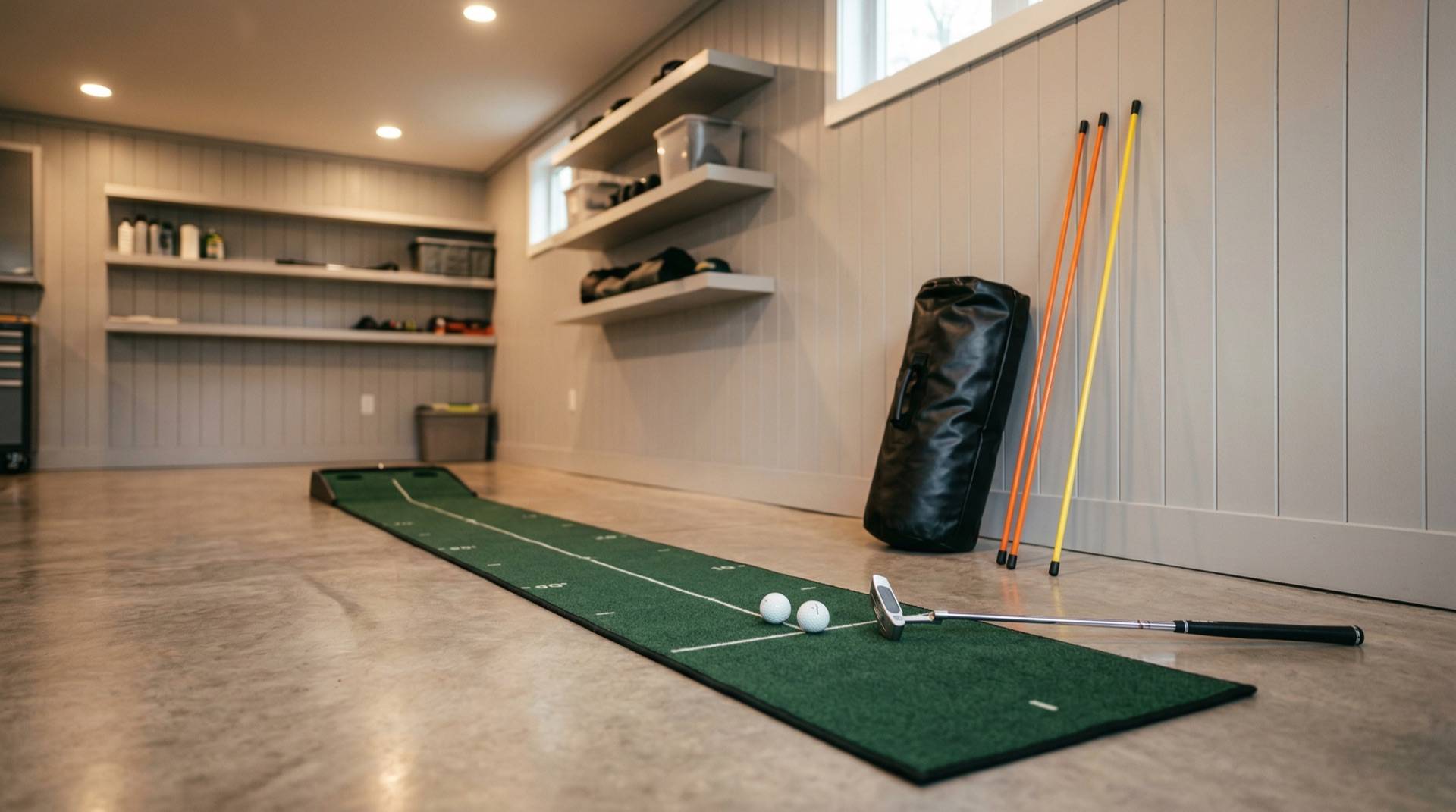
The short version: for putting, the Putting Arc T3 gives pass-fail feedback on stroke path and start line with every rep. For short game, the eGolfRing Target Rings turn chipping practice into a measurable accuracy drill instead of aimless repetition. Both are worth a look if your self-assessment points at the scoring clubs first.
The Proof Window: How to Know an Aid Is Working in 14 Days
Every training aid on this page comes with a number, because a training aid you cannot verify is a training aid you will quietly stop using. The Proof Window is the same deal for all four: a day-one test that establishes your baseline, a 14-day pass standard built on three short sessions a week, and a clear answer for what it means if the number does not move. Fourteen days is enough. If the standard is not trending by then, the aid is solving a problem you do not have — and that is what return windows are for.
| Aid | The miss it fixes | Day-one test | 14-day pass standard | If it fails |
|---|---|---|---|---|
| The Connector | Arms outrunning the pivot | 10 slow half-swings; count pad separations | 1 or fewer separations of 10 at half speed, 3 or fewer at three-quarter speed | If separations are not trending down by day 7, the limiter is body rotation, not connection — see the TRS row |
| Pro-Slot Trainer | Over-the-top transition | 10 slow rehearsals; count reps that flow through the slot without catching | 8 of 10 flowing at rehearsal speed, and range ball flight confirming the new start line | If reps stay catchy at slow speed, the problem is upstream — setup or grip — not plane |
| TRS Slider | Stalled rotation, trail arm flaring | 10 quarter-swing turns; count reps where the slider holds position | 8 of 10 held at half-swing speed | If the arm pulls away even at quarter speed, slow down further — speed is hiding the stall, not fixing it |
| Compression Training Ball | Flip or scoop through impact | 10 slow-motion swings; count reps where the ball stays in place | 10 of 10 at full speed | If the ball only drops at speed, the flip is a sequencing issue — tempo work comes before more reps |
Two rules make the window honest. First, run the day-one test the day the aid arrives and write the number down — a baseline recorded after a week of practice is not a baseline. Second, test at the same speed every time. Passing at half speed and failing at full speed is not a contradiction; it is a progress report, and it tells you exactly where the next sessions go.
When Two Aids Look Like the Right Answer
Miss patterns overlap, and the overlap is where most wrong purchases happen. Three cases come up constantly. Each one has a cheap disambiguation test you can run before any money moves.
The pull. A pull can come from arms outracing the body or from an over-the-top path — different problems, different aids. Read the curve and the contact. A pull that flies relatively straight, with thin or flippy contact, points at connection: the arms arrived early. That is Connector territory. A pull that starts left and curves farther left, or alternates with a slice, points at path: the club is coming down steep and across. That is the Pro-Slot's job.
Thin contact. Thin with a pull bias and no divot is usually the arms beating the turn — connection again. Thin with high, weak flight, shallow or missing divots, and a soft feeling at impact is the scoop: the wrists are adding loft to help the ball up. That is the Compression Training Ball's problem, and it is the one most golfers misdiagnose because the ball still gets airborne.
Inconsistency that changes by the day. If the misses get worse under pressure or late in the round, the body is stalling and the hands are timing the face — rotation work, which is the TRS Slider. If the misses are random from the first swing and your aim and ball position wander session to session, the problem is setup variance, and the fix is free: run the mirror setup reset drill for two weeks before buying anything. An aid cannot stabilize a swing that starts from a different position every day.
One aid at a time, always. Buy for the diagnosed miss, run the Proof Window, and let the number — not the marketing — decide whether it stays.
What I Would Actually Buy First
This is the section most training aid articles leave out because it is bad for sales: the honest answer about purchase order.
Despite featuring four full-swing products above, the single best first purchase for most golfers is still a putting trainer. Not because full-swing work does not matter, but because putting accounts for roughly 40% of all strokes and can be practiced in a hallway in ten minutes. The feedback loop is tighter, the reps are easier to accumulate, and the score impact shows up faster.
The four swing trainers in this article solve real problems. But they solve them best when the golfer has already identified the specific miss pattern and committed to structured practice three or more times a week. Buying a swing plane trainer after one frustrating range session is how training aids end up in the garage.
So here is the order I would suggest: start with whatever matches the clearest, most repetitive miss - the one that shows up when you are calm and trying, not just when you are tired or rushing. If that miss is putting speed or start line, buy a putting aid. If it is short game contact, buy a target system. If it is a specific, diagnosable full-swing fault - arms disconnecting, steep plane, poor rotation, or impact collapse - that is when these four products become the best money you can spend.
If you want help matching the diagnosis to the tool, our buying framework article walks through the full self-assessment with benchmarks for each category.